
NLA Salary War: Inside the 13% Pay Dispute, GHS 5m Tax Bill and Questions Over the Authority Finances
It will remain a question of who controls the money, who benefits from it and whether the National Lottery Authority is delivering value to its workers, the government and the Ghanaian public.
 HENRY GERCHI
I conducted a deeper investigation using current NLA statements, the Ghana Audit Service, SIGA financial data, reports from the NLA staff union, management statements and reporting on the NLA’s business arrangements.


The most important finding is that the dispute is not simply a story about a 13% salary cut. The evidence points to a more complicated fight involving tax deductions, a disputed salary increase, staff welfare, operational failures, the NLA’s financial position, the KGL contract and trust between management and the union.
The key finding
As of 24 August 2026, NLA workers have actually begun a sit down strike and demonstration over the salary dispute. The union wanted a 17% increase, management offered 12%, while the Fair Wages and Salaries Commission reportedly advised an 8% increase based on the NLA’s financial strength.
The alleged 13% salary reduction appears to relate primarily to reduced take home pay after the NLA corrected an income tax problem affecting salaries from 2016 to 2022, rather than management formally cutting employees’ basic salaries by 13%.
Management says the NLA had to settle more than GH¢5 million in tax liabilities arising from the incorrect application of income tax. It says the Authority absorbed the liability, but the correction of tax rates going forward reduced employees’ net salaries.
That distinction is crucial for responsible journalism.
NLA STAFF VERSUS MANAGEMENT
What is really behind the dispute?
The dispute has developed around at least six major issues:
- Take home pay
- 2026 salary negotiations
- Tax liabilities dating back to 2016
- Staff promotions and Scheme of Service
- Working equipment and vehicles
- Trust between the union and management
The union’s position is that workers are financially worse off because of the tax adjustment and therefore the proposed 12% increase does not adequately compensate them. Reports indicate that some workers experienced deductions of roughly 10% to 13% in take home pay after the tax correction.
Management’s position is different.
It says there was no 13% salary cut and that the current administration did not reduce employees’ contractual salaries. Instead, the Authority says staff compensation included an 8% utility allowance inherited from the previous administration and a 5% basic salary increase, producing an overall 13 percentage point improvement in the compensation package.
This is where the language of the dispute becomes important.
Gross salary and net salary are not the same thing.
A worker can receive an increase in gross pay but still take home less money if statutory deductions rise significantly.
That appears to be one of the central reasons the two sides describe the same situation differently.
Is NLA actually losing money?
The answer from the audited figures is: not in 2024.
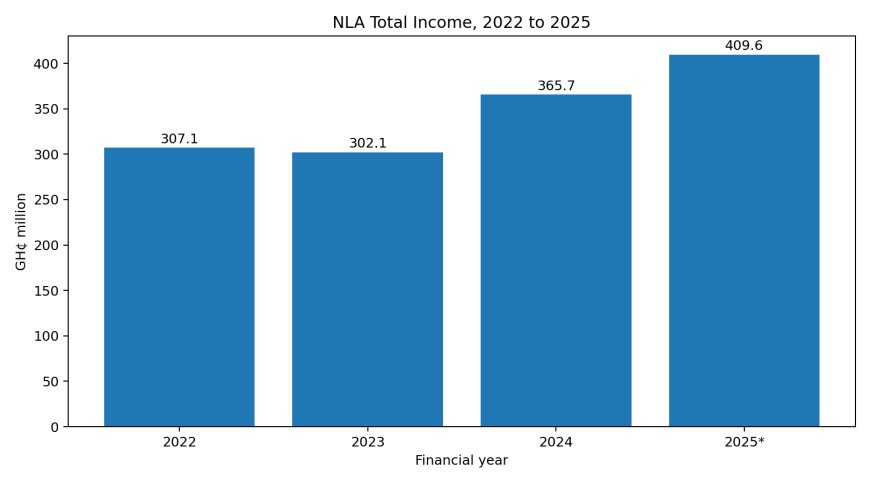
The latest audited financial information available gives a very different picture from the idea that NLA was simply running out of money.
The Ghana Audit Service reported that NLA’s:
|
Indicator |
2022 |
2023 |
2024 |
|
Total income |
GH¢307.11m |
GH¢302.05m |
GH¢365.67m |
|
Total expenditure |
GH¢304.54m |
GH¢299.33m |
GH¢356.65m |
|
Surplus |
GH¢2.56m |
GH¢2.72m |
GH¢9.03m |
The 2024 figures show income increasing by 21.06%, while expenditure increased by about 19.15%. NLA therefore ended 2024 with a surplus of approximately GH¢9.03 million, compared with GH¢2.72 million in 2023.
This matters.
If management argues that NLA cannot afford a larger salary increase, the question should not simply be:
“Is NLA making a loss?”
The more important questions are:
How much cash is actually available?
What are NLA’s fixed obligations?
How much of its income is already committed to prizes, commissions, technical services and other operational expenses?
What amount of the 2024 surplus was actually available for staff remuneration?
What did the 2025 accounts show?
The 2025 audited financial statements are particularly important because management says revenue increased by 12% in 2025.
Using the 2024 audited income of GH¢365.67 million as a base, a 12% increase would imply approximately GH¢409.55 million in 2025 income.
But this is an estimate, not an audited 2025 figure.
Chart data
So why is management saying money is tight?
Because revenue is not the same thing as free cash.
NLA’s audited 2023 accounts show how expensive the business is to operate.
In 2023:
- Direct operating expenses were GH¢142.23 million
- Selling and distribution expenses were GH¢11.64 million
- Administrative and general expenses were GH¢69.07 million
- Personnel costs were GH¢76.39 million
- Total expenditure was GH¢299.33 million
Personnel costs alone represented about 25.3% of total income in 2023.
This means even a seemingly modest salary adjustment can have a significant impact on NLA’s annual expenditure.
However, that does not automatically prove that a 17% increase is unaffordable.
To determine that properly, journalists need the 2025 audited financial statements, payroll cost, staff numbers, cash position, debt obligations and budget approved for 2026.
Those figures should be demanded from NLA.
The GH¢5 million tax issue
This may be the most important financial discovery in the current dispute.
NLA says the Ghana Revenue Authority identified a tax problem involving staff salaries from 2016 to 2022.
The Authority says the incorrect tax application resulted in more than GH¢5 million in tax liabilities.
Management says it agreed to absorb the liability instead of passing the historical liability directly to workers. But it also began applying the correct tax rates going forward.
That correction reduced workers’ net salaries.
So the argument can be simplified this way:
Management’s position
“We did not cut your salary. We corrected a tax problem and absorbed more than GH¢5 million of historical liability.”
Workers’ position
“Whatever management calls it, our take home pay has fallen and the proposed increase is not enough to compensate us.”
Both sides can therefore be describing different parts of the same financial event.
The salary battle
There are now three important figures.
|
Position |
Salary proposal |
|
FWSC recommendation |
8% |
|
NLA management offer |
12% |
|
Staff union demand |
17% |
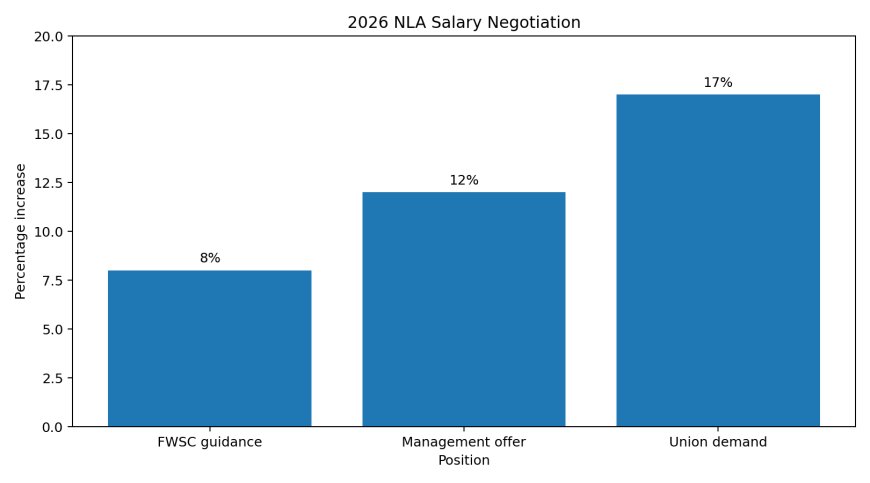
Management says the Board initially approved only 10%, before management secured another two percentage points to reach 12%.
But the union rejected that offer.
The matter was referred to the National Labour Commission.
And now, on 24 August 2026, workers have embarked on industrial action.
What did Mohammed Abdul Salam promise?
When Mohammed Abdul Salam took over in January 2025, the message was one of collaboration.
At his introduction, he said he would engage staff and the union and learn from their experience.
Over the following months, several commitments and objectives emerged.
1. Improve staff welfare
Management repeatedly said staff welfare was a priority.
2. Replace obsolete POS machines
Management announced a partnership with Fidelity Bank to procure 5,000 POS machines.
The machines are expected to improve market access and facilitate instant payments of winnings up to GH¢30,000.
However, as of the June 2026 management statement, the project was still at the final contract stage.
3. Introduce the Scheme of Service
The Scheme of Service was intended to address career progression, promotions and staff stagnation.
Management says the Board has considered it and forwarded it to the Public Services Commission for approval and implementation.
That means:
Started: Yes
Completed: No
4. Health Insurance
Management says it secured a broker, appointed a service provider and paid the premium.
However, staff information was still being collected for enrolment.
So again:
Financial commitment made: Yes
Fully implemented for staff: Not yet confirmed.
5. Replace unsafe vehicles
Management admits the vehicles are in poor condition.
A request was submitted to the Ministry of Finance for approval to procure new vehicles.
But approval was still pending as of the latest detailed management statement.
Therefore:
Promise: Yes
New vehicles delivered: No evidence found.
6. Improve payment of winnings
Management says payment of winnings improved significantly and contributed to a 12% increase in revenue in 2025.
It also says staff bonuses were paid and statutory obligations, including SSNIT and provident fund contributions that had been in arrears, were brought up to date.
This is one of the stronger claims management can point to.
What are staff complaining about?
The dispute is much bigger than salaries.
In June, the union raised concerns over:
- obsolete POS machines
- poor office conditions
- deteriorating accommodation
- unsafe vehicles
- lack of working laptops
- inadequate printers and photocopiers
- stationery shortages
- delayed promotions
- the Scheme of Service
- health insurance
- alleged recruitment irregularities
- alleged weak consultation
- delayed lottery winnings
- illegal lottery operators
- software procurement
- regulatory enforcement
- salary negotiations
The union gave management a deadline and threatened industrial action.
This suggests the salary dispute is actually the latest expression of a wider breakdown in confidence between employees and management.
The bigger business question: where is NLA’s money coming from?
This is where the investigation becomes more interesting.
NLA does not have one single revenue stream.
The audited accounts identify at least two major categories:
Lotto intake
2023:
GH¢164.88 million
2022:
GH¢177.94 million
Miscellaneous income
2023:
GH¢137.17 million
2022:
GH¢129.17 million
Therefore, in 2023, miscellaneous income accounted for almost 45.4% of NLA’s total income.
This is important because if an arbitration process or public debate focuses on only one income stream, it can potentially give an incomplete picture of the Authority’s finances.
However, I have not found documentary evidence proving the allegation that the DG deliberately presented only one revenue stream during arbitration.
That allegation should therefore remain clearly attributed to the union until the arbitration documents are obtained.
The KGL question
This is arguably the most important business story surrounding NLA.
The Fourth Estate investigated the NLA’s KGL arrangement and reported that KGL’s 5/90 online lottery generated more than GH¢3 billion in 2024, while the contract required payments to NLA of about GH¢157.6 million in 2024 across three contracts.
The investigation reported that the 2024 payment represented approximately 5.2% of KGL’s reported revenue from the NLA’s 5/90 online lottery.
The same investigation reported that NLA’s revenue had fallen from approximately GH¢366 million in 2015 to GH¢296.58 million in 2023, based on SIGA data.
That raises a major question:
If the lottery market is generating billions of cedis, why is NLA’s own recognised income measured in hundreds of millions?
That is not necessarily evidence of wrongdoing.
Lottery businesses have substantial prize, commission, technology and distribution costs.
But it is an important public finance question.
KGL payments in 2025
According to figures reported by GNA from a statement concerning NLA’s licensed operators, KGL paid GH¢173.36 million to NLA in 2025.
The other 29 listed licensed collaborators and private lottery operators collectively paid approximately GH¢44.9 million.
That means KGL alone accounted for roughly 79.4% of the GH¢218.26 million in payments represented by those two categories.
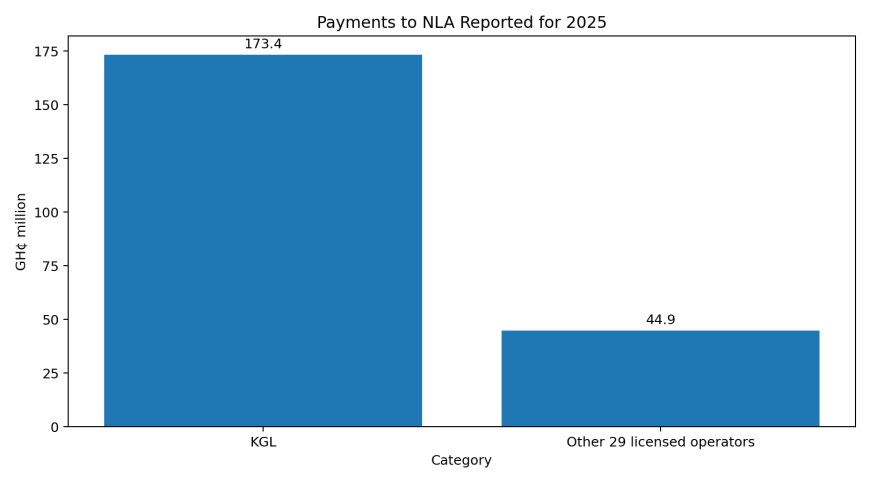
This is why the KGL agreement deserves serious scrutiny in any investigation into NLA’s finances.
The former DG versus the current DG
The comparison must be handled carefully because Samuel Awuku’s tenure covered roughly 2021 to January 2025, while Mohammed Abdul Salam took over in January 2025.
Samuel Awuku
During Awuku’s tenure, reports credit his administration with:
- clearing outstanding lottery winnings
- salary increases
- delayed promotions
- staff training
- stronger engagement with the union
- efforts against illegal lottery operators
- international recognition for NLA
- expansion of lottery operations
A 2025 profile of the outgoing administration reported that Awuku had cleared outstanding winnings and worked on staff welfare and promotions.
However, his administration also left behind controversial questions surrounding the KGL arrangements.
The Fourth Estate reported that Awuku and the board renewed and subsequently entered into long term arrangements with KGL, including a 15 year contract running from 2024 to 2039 with a possible five year renewal.
Mohammed Abdul Salam
Under Abdul Salam, management reports:
- improved payment of winnings
- 12% revenue growth in 2025
- payment of staff bonuses
- clearance of SSNIT and provident fund arrears
- progress on the Scheme of Service
- health insurance preparations
- proposed 5,000 POS machines
- efforts to improve enforcement
- consideration of renegotiating the KGL arrangement
Interestingly, Abdul Salam himself told Parliament’s Public Accounts Committee in October 2025 that the state could obtain more from the KGL agreement and that the contract should be renegotiated.
What has actually been completed?
Here is the evidence based scorecard.
|
Issue |
Management says |
Evidence status |
|
Revenue growth |
Revenue increased 12% in 2025 |
Reported by management, needs audited confirmation |
|
Payment of winnings |
Improved significantly |
Management claim |
|
Staff bonuses |
Paid |
Management claim |
|
SSNIT and provident fund |
Arrears cleared |
Management claim |
|
5,000 POS machines |
Procurement underway |
Not fully completed |
|
Health insurance |
Premium paid, enrolment underway |
Partly implemented |
|
Scheme of Service |
Sent to PSC |
Not fully implemented |
|
New operational vehicles |
Request submitted |
Not completed |
|
Salary increase |
12% offered |
Disputed, not accepted by union |
|
Union demand |
17% |
Not granted |
|
FWSC recommendation |
8% |
Not implemented as final settlement |
|
Tax problem |
GH¢5m+ liability absorbed by NLA |
Management says completed arrangement |
Why are workers angry if revenue increased?
This is perhaps the strongest question for the story.
The NLA’s own figures suggest business performance improved.
But improved organisational revenue does not necessarily mean workers’ personal financial situation improved.
The problem is that employees judge their welfare by:
What enters their bank account.
Not:
What appears as total NLA revenue.
If an employee’s gross salary rises by 5% but tax and other deductions cause take home pay to fall, the worker will understandably experience the situation as a pay cut.
That appears to be the heart of the current conflict.
Is the DG personally responsible for the 13%?
There is currently no solid evidence establishing that Mohammed Abdul Salam personally ordered a 13% salary cut.
In April 2026, NLA management explicitly denied that the DG had reduced salaries by 13% or any other percentage.
The latest August statement provides a more detailed explanation: the tax issue originated from an incorrect income tax application covering 2016 to 2022, before Abdul Salam became DG.
That weakens any simplistic claim that Abdul Salam personally created the original tax problem.
However, he is responsible for decisions made under his administration, including how the Authority responds to the tax issue and how much salary increase management is prepared to offer workers.
Who benefits from the current situation?
This question deserves careful treatment.
Workers
They want higher take home pay, better working conditions, career progression and stronger welfare protection.
Management
Management benefits from keeping personnel costs within its approved budget and protecting the Authority’s financial position.
Government
Government benefits if NLA generates more sustainable revenue for national development.
Lotto Marketing Companies
They benefit from a financially stable NLA and functioning lottery infrastructure.
Private lottery operators
They benefit from regulatory clarity and access to the market.
KGL
KGL is particularly significant because of the scale of its reported business and payments to NLA.
The Ghanaian public
Ultimately, the public has an interest in an NLA that generates maximum value from Ghana’s lottery industry while maintaining proper governance.
The most worrying finding
The financial figures do not support the simple argument that:
“NLA is losing money, therefore management had to cut salaries.”
The audited 2024 accounts actually show a GH¢9.03 million surplus.
At the same time, the Authority is facing genuine financial pressures.
The most significant immediate financial pressure disclosed by management is the more than GH¢5 million tax liability connected to historical staff salary taxation.
Therefore, the real question should be:
If NLA is generating hundreds of millions of cedis and reported a 2024 surplus and 2025 revenue growth, how much of its financial capacity can reasonably be directed towards staff welfare without damaging the Authority’s ability to operate?
That question cannot be answered responsibly without the 2025 audited accounts and 2026 approved budget.
A major red flag for further investigation
There is a significant gap between the scale of the lottery market and the amount formally recognised as NLA income.
The Fourth Estate reported that KGL’s 5/90 operation alone generated more than GH¢3 billion in 2024, while NLA’s total recognised income was GH¢365.67 million in the 2024 State Ownership Report.
That does not mean NLA should have received GH¢3 billion.
It means journalists need to understand the contractual economics:
How much does the player stake?
How much goes to winners?
How much goes to Lotto Marketing Companies?
How much goes to technology providers?
How much goes to telecommunications companies?
How much goes to government?
How much remains with NLA?
How are these amounts calculated and audited?
Those questions are more important to Ghana’s public finances than simply arguing over whether staff should receive 12% or 17%.
Data driven conclusion
The evidence currently available points to a management and labour relations crisis rather than a simple financial collapse.
NLA’s audited income increased from GH¢302.05 million in 2023 to GH¢365.67 million in 2024, while its surplus rose from GH¢2.72 million to GH¢9.03 million.
Management says revenue then increased by another 12% in 2025, although the audited 2025 accounts are needed to independently verify the full financial picture.
At the same time, the organisation faces operational problems acknowledged by management itself, including poor vehicles, obsolete POS equipment, delayed Scheme of Service implementation and the need to complete staff health insurance arrangements.
The salary controversy is therefore not adequately described as “NLA cut salaries by 13%”.
A more accurate description is:
Workers say their take home pay fell by roughly 10% to 13% following the correction of a historical tax problem and that the proposed 12% salary increase is insufficient. Management says it did not cut salaries, absorbed more than GH¢5 million in historical tax liabilities and offered a 12% increase despite financial constraints. The union wants 17%, while FWSC reportedly advised 8%.
And as of 24 August 2026, the dispute has escalated into a sit down strike and demonstration, with the NLA asking workers to return to negotiations while the matter proceeds through the National Labour Commission.